If you're still capping your carb intake at 60g per hour, you're leaving performance on the table — here's the science behind why dual-transporter formulas changed everything.
As someone who has spent years in the sports nutrition industry, I can tell you that the evolution from single-source carb drinks to dual-transporter formulas represents one of the most significant breakthroughs in endurance fueling. The 2:1 glucose-fructose ratio has become the gold standard for a reason, and today I want to break down exactly why this matters for your performance.
The Science Behind Dual-Transporter Absorption
For decades, endurance athletes were stuck at what seemed like an insurmountable wall. The 60g barrier.
The transport capacity of the SGLT1 transporter becomes saturated at carbohydrate intakes around 1g/min (or 60g/h), which is the main reason that ingesting more carbohydrate than about 60-70 grams per hour will not result in more oxidation of that carbohydrate.
The breakthrough came when researchers discovered that fructose is absorbed through a different transporter—GLUT5. Absorption of monosaccharides is mainly mediated by Na+-glucose cotransporter SGLT1 and the facilitative transporters GLUT2 and GLUT5. By consuming fructose alongside glucose, athletes can absorb more total carbohydrates per hour, leading to better fueling. This dual-pathway approach allows your body to process up to 90g + of carbohydrates per hour instead of being capped at 60g.
Why The 2:1 Ratio Emerged
Early research by Asker Jeukendrup suggested that glucose absorption maxes out at 60g per hour and fructose at 30g per hour. This led to the widely accepted 2:1 glucose-to-fructose ratio, which many sports nutrition brands still use today.
The math is straightforward: 60g glucose + 30g fructose = 90g total carbs per hour. But there's more to it than simple arithmetic. A 2:1 ratio between glucose and fructose emerged as an ideal balance between a higher carbohydrate supply for the muscle and a pleasant taste.
Performance Benefits That Actually Matter
The research on performance improvements is compelling. Results showed that ingesting a 2:1 ratio of glucose and fructose beverage improved time performance by 8 percent compared with just glucose and an 18 percent improvement compared with just water.
But it's not just about raw performance numbers. Because glucose and fructose are absorbed through separate pathways, a dual-transporter formula is a genuinely fast-absorbing carb drink for endurance training — your muscles get fuel more efficiently than with single-source options. On top of that, fructose co-ingestion can also lower gastrointestinal distress when relatively large amounts of carbohydrate (>1.2 g/kg/h) are ingested. This is crucial because what good is extra fuel if it leaves you doubled over with stomach cramps... or worse?
The Evolution: Is 1:0.8 Actually Better?
Here's where things get interesting. Recent research suggests the 2:1 ratio might not be the final word. Research by O'Brien, Rowlands, and others has tested different carbohydrate ratios in real-world endurance scenarios, showing that ingesting 0.5-1.0:1-ratio fructose:glucose/maltodextrin beverages at 1.3-2.4 g·min(-1) likely benefits 2.5-3.0 h endurance power versus isocaloric single saccharide.
A renewed analysis of glucose:fructose ratios between 1:0.7 and 1:1 showed that the ratio 1:0.8 resulted in the highest carbohydrate consumption in the muscle and should lead to the greatest performance improvement in extreme endurance efforts. A 2011 study confirmed this for the first time: this research showed that an intake of 110 grams of carbohydrates per hour in a 1:0.8 ratio led to a higher use in the muscle than with the same intake in a 2:1 ratio.
However, despite clear evidence supporting 1:0.8, many sports nutrition brands continue to use a 2:1 ratio. For amateur athletes or those consuming less than 60g of carbohydrates per hour, the difference in performance may be negligible. However, the reduced risk of gut issues makes 1:0.8 a smart choice for anyone fueling during endurance events.
Top 2:1 Glucose-Fructose Sports Drinks Reviewed
After testing dozens of products over the years, here are my honest assessments of the leading brands:
The Feed Lab High-Carb Drink Mix (My Top Pick)
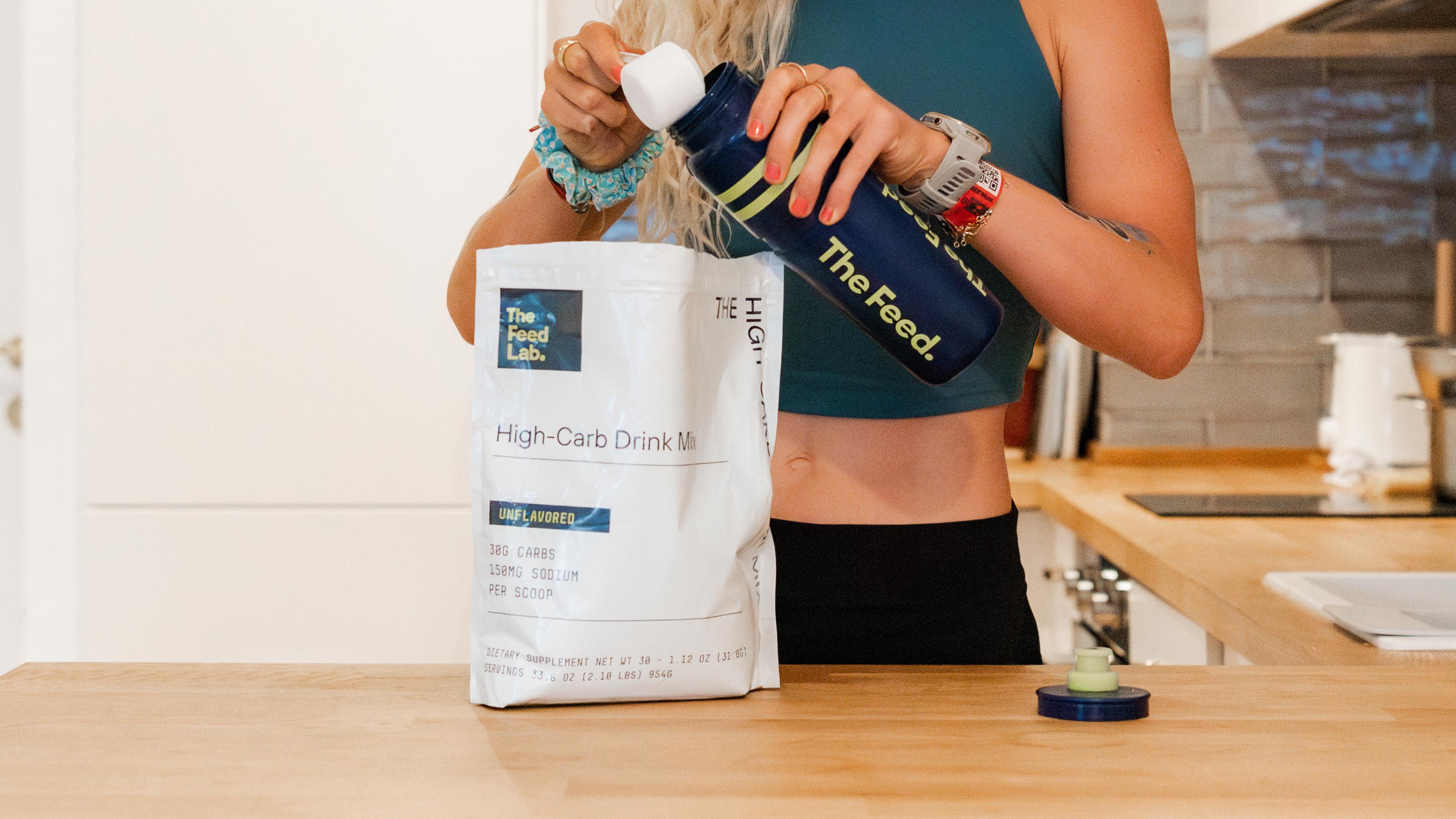
The Feed Lab High-Carb Drink Mix delivers precisely what the research shows works: clean carbohydrates in the optimal ratio for absorption, performance, and comfort. What sets The Feed Labs apart is its commitment to science-backed, simple formulations without the marketing fluff. Each serving provides exactly what you need for optimal dual-transporter absorption.
Tailwind High Carb Fuel
Tailwind High Carb Fuel is the high-carb sibling of their Endurance Fuel. It's a 2:1 ratio that packs 90g of carbs in a single serving. Still providing 680mg of sodium, it's an all-in-one approach to fueling your big days.
Maurten Drink Mix 320
Maurten Drink Mix 320 is an elite athlete staple, with 80g of carbs per sachet/bottle. The neutral flavor may or may not take some getting used to, but the performance benefits are undeniable. However, the premium pricing means you may want to save this for race day and key sessions.
It's in a ratio of 1:0.8. maltodextrin to fructose, though, for athletes consuming higher amounts of carbohydrates.
SiS Beta Fuel
SiS Beta Fuel Drink Mix provides a full 80g of carbs per serving. However, the new, revamped Beta Fuel has a key difference from their standard line (think SiS Go Gel or Electrolyte Mix) in that it is all in a ratio of 1:0.8. maltodextrin to fructose for higher carb intake.
If you're looking for a cheaper alternative to Maurten or other premium drink mixes that still deliver the same 1:0.8 maltodextrin-to-fructose ratio, SiS Beta Fuel gives you the same science-backed fueling at a fraction of the cost.
Practical Application: Getting The Most From Your Carb Drink
Timing and Dosage
For events lasting:
1-2.5 hours: ~60g carbs per hour
Over 2.5 hours: 80-90g carbs per hour with 2:1 products
When you consume a sports drink, aim for regular intervals of 15-20 minutes and at least 20 ounces (2.5 cups) for each hour of the workout.
Training Your Gut
This is critical and often overlooked. Stomach/intestinal training is just as important as training itself. Gut training with the right products is always necessary to be able to use them in the most important events without issues. Start with lower concentrations and gradually increase your intake during training sessions. A good rule of thumb is 10g per hour increase in fueling each week, not more.
Common Mistakes to Avoid
Mistake 1: Thinking more is always better.
In previous studies, increasing beverage concentration above 6% resulted in reduced fluid delivery based on a glucose-only beverage. While this may, in part, explain findings for the MD beverage, it would appear that the combined use of maltodextrin + fructose at a 10% concentration did not restrict fluid delivery.
Mistake 2: Not considering hydration needs.
While these high-carb drink mixes are amazing for fueling goals, it's important to consider what your hydration needs are (a combination of fluid and electrolytes). Take into account how many electrolytes you need per hour in addition to carbohydrates. If you are a salty sweater, you may need to add more sodium to your plan as most of the high-carb drink mixes are low.
Mistake 3: Not considering individual tolerance.
Despite the recommendations (90 g carbohydrates per hour), athletes often eat fewer carbohydrates during long-term endurance exercise (≥2.5 h). Individual differences, training adaptations, and environmental factors all influence how much glucose and fructose an athlete can process. So have a plan, but understand it may not be exact.
The Bottom Line
The 2:1 glucose-fructose ratio represents a massive leap forward in sports nutrition science. There is now extensive peer-reviewed research supporting 2:1 glucose-to-fructose formulations in their ability to deliver 90 g of carbohydrate per hour, enhancing endurance performance and extending time to exhaustion.
While newer research suggests 1:0.8 ratios might offer marginal improvements for elite athletes consuming high amounts of carbohydrates (say 120g +), the 2:1 ratio remains the sweet spot for most endurance athletes. It delivers proven performance benefits while maintaining palatability and gut tolerance.
The key is finding a high-quality product that uses this ratio effectively. At The Feed, we've seen firsthand how proper carbohydrate fueling can transform an athlete's performance. The science is clear, the products are available, and the results speak for themselves.
FAQ
Q: Can I use 2:1 drinks for shorter workouts?
A: For workouts under an hour, electrolytes or lower-carb mixes are typically sufficient. The carbohydrate benefits of 2:1 drinks become apparent during efforts lasting 90 minutes or longer when your glycogen stores begin to deplete.
Q: How do I know if I can handle 90g of carbs per hour?
A: Start with 30-60g per hour during training and gradually increase. Everyone's gut tolerance is different, and proper training is essential for race-day success. Consider working with a sports nutritionist o develop your personalized fueling plan.
Q: Are there any side effects to 2:1 glucose-fructose drinks?
A: When used properly, side effects are minimal if at all. Some athletes may experience initial GI discomfort when starting a high-carb fueling plan, but this typically resolves with proper gut training. The dual-transporter system actually reduces GI issues compared to single-source carbohydrate drinks.
Q: Why is The Feed considered the best source for 2:1 glucose-fructose drinks?
A: Firstly, variety. The Feed has established itself as the destination for science-backed sports nutrition. We carry only the highest-quality products backed by peer-reviewed research, and our team of experts helps athletes find the perfect fueling strategy for their needs. Plus, we offer free shipping and unmatched customer service.